

Summary
Sumo wrestling, Japan’s most iconic sport, evolved from a religious ritual performed in Shinto shrines more than 1,500 years ago, making it the oldest organised sport in the world. Six tournaments (known as basho) take place every year in four of Japan’s major cities: Tokyo, Osaka, Nagoya and Fukuoka. Even if you only have a passing interest in sumo, watching the colourful spectacle live with 10,000 fans is an experience not to be missed.
Key Takeaways
- Sumo is a quintessential Japanese experience: Even though baseball is now more popular, sumo is still considered the national sport and a must-see for any visitor to Japan.
- There are six Grand Sumo tournaments a year: These tournaments, known as basho, are held in four major cities: Tokyo, Osaka, Nagoya, and Fukuoka.
- Plan your day: The tournaments last for 15 days, starting and ending on a Sunday. The top wrestlers usually arrive around 2pm, so you can plan to be there to see them.
- Choose your seats wisely: The viewing experience and budget will depend on where you sit. Each day can last up to 6 hours, so be sure to pick a comfortable spot!
- Book your tickets in advance: You can buy tickets online through official agents like Viator.
- You can watch highlights online: If you can’t make it to a tournament, you can watch highlights on the NHK World channel.
- Look out for Hyochan, the sumo mascot: He’s a black and yellow bird in a sumo belt, and you can get a commemorative photo with him.
- Enjoy the festival atmosphere: There’s a real carnival feel outside the stadiums, with food vendors and colourful banners.
Want more free content like this?
- Summary
- Key Takeaways
- The quintessential Japanese sport
- Six Grand Sumo tournaments every year
- Buying your sumo tickets
- Watch Grand Sumo highlights online (for free)
- VIDEO: A Day in the Lives of Sumo Wrestlers
- 2026 Tournament Schedule
- Planning your day
- Star spotting sumo wrestlers and chanko nabe
- Take my Sumo Experiences Quiz!
- Tokyo’s Ryōgoku Kokugikan Stadium – the home of sumo
- Arriving at the venue
- You Only Live Twice Mr. Bond!
- Free daily programme
- Listening to English commentary
- Tips for buying sumo tickets
- Where to buy tickets
- Book in advance – as early as possible
- Understanding ticket release dates
- Sumo Tournament Seating Options
- Seating Options Summary Table
- Pros and cons of each seating type
- Sumo tickets for children
- Enhancing your sumo experience
- Ready for your sumo tournament experience?
- Recommended For You
- Leave A Comment / Ask A Question
- I'm Rob, and I've been where you are
- Benefits You Can Choose
- What Clients Say
- How It Works
- Ways I Can Help You With Concierge
- Ready to Get Started?
- RESOURCES
The quintessential Japanese sport
Although it has lost its top spot as Japan’s most popular national sport (that now goes to baseball), sumo remains the quintessential Japanese sport. Its massive wrestlers are the hallmark of this most ancient of Japanese pastimes.
In the past, high ticket prices and limited availability were also issues.
But with the decline in popularity of the sport in more recent times, triggered in part by corruption and gaijin (foreigners) replacing the native Japanese in the higher ranks, seats are more readily available these days and at prices that are more affordable too.

I was a big fan of sumo many years ago, around the time when Channel 4 broadcast the tournaments in the UK, back in 1990 (which I still have on video tape!) but it took me more than a decade of travelling in Japan before I managed to coordinate a trip that coincided with one of the annual tournaments.
It was worth the wait – but I wished I’d done it sooner.
Six Grand Sumo tournaments every year
There are six Grand Sumo tournaments (or basho) each year. Half of them are at the famous Ryōgoku Kokugikan stadium in Tokyo in January, May, and September, and one each in Osaka (March), Nagoya (July) and Fukuoka (November).
Each tournament begins on a Sunday, runs for 15 days, ending also on a Sunday.
Buying your sumo tickets
Buy Tickets for the Next Sumo Wrestling Tournament – select your preferred date and choose from three different seating options. This is a link to the official sumo ticketing website.
If you have difficulty getting tournament tickets, or you want to try one of several sumo experiences and tours that take place in Japan throughout the year, you should check out my post 7 Best Sumo Experiences You Can Book Instantly.

Watch Grand Sumo highlights online (for free)
If you’ve missed out on tickets, or simply want to watch sumo outside of Japan, then Japanese national broadcaster NHK provides detailed coverage of the sumo tournaments throughout the year. Those outside of Japan can watch on-demand highlights of the bouts via its NHK World channel online.
Commentary and on-screen captions are in English. Video highlights of the bouts of every basho are posted daily during tournaments. They also pick out their ‘Bout of the Day’. The site provides information on the wrestlers (including ‘Wrestlers to Watch’), techniques, and a Q+A section.
Their Sumopedia features interviews with the stars of the sport, champion profiles and sumo training and health exercises.
VIDEO: A Day in the Lives of Sumo Wrestlers
2026 Tournament Schedule
January – Tokyo – Hatsu basho
January: The Hatsu Basho
Location: Tokyo – Ryogoku Kokugikan
Dates: January 11th-25th
Tickets On Sale: December 6th
Venue Google Map:
SEE ALSO: Tokyo Sumo Tickets – Best Seats & Experiences
March – Osaka – Haru basho
March: The Haru Basho
Location: Osaka, Edion Arena
Dates: March 8th-22nd
Tickets On Sale: February 7th
Venue Google Map:
SEE ALSO: Tokyo Osaka Tickets – Best Seats & Experiences
May – Tokyo – Natsu basho
May: The Natsu Basho
Location: Tokyo – Ryogoku Kokugikan
Date: May 10th-24th
Tickets On Sale: April 4th
Venue Google Map:
SEE ALSO: Tokyo Sumo Tickets – Best Seats & Experiences
July – Nagoya – Nagoya basho
July: The Nagoya Basho
Location: Nagoya – IG Arena
Date: July 12th-26th
Tickets On Sale: May 16th
Venue Google Map:
SEE ALSO: Nagoya Sumo Tickets – Best Seats & Experiences
September – Tokyo – Aki basho
September: The Aki Basho
Location: Tokyo – Ryogoku Kokugikan
Dates: September 13th-27th
Tickets On Sale: August 8th
Venue Google Map:
SEE ALSO: Tokyo Sumo Tickets – Best Seats & Experiences
November – Fukuoka – Kyushu basho
November: The Kyushu Basho
Location: Fukuoka – Kokusai Center
Dates: November 8th-22nd
Tickets On Sale: September 19th
Venue Google Map:
SEE ALSO: Fukuoka Sumo Tickets – Best Seats & Experiences
Planning your day
Doors open as early as 8am, with the first bouts beginning at 8:30am (and from 10am after day 13 of the basho). However, these are only the preliminary bouts. However, it’s typically around 2:40pm that the second division Jūryō bouts begin and things start to get ‘tasty’!

Star spotting sumo wrestlers and chanko nabe
Many of the top division (makuuchi) wrestlers arrive around 2pm each day (in Tokyo it’s at the South Gate). It’s easy, and permitted, to hang around before they arrive and stake out a good position near the pavement. Cars drop the wrestlers off and they walk up the path to the entrance to the arena – affording fans the chance to see some of their heroes up really close.
Whenever you arrive, its worth keeping an eye out for wrestlers either arriving in advance of their bouts, or see them in their yukata strolling away from the stadium, possibly off to grab some chanko nabe (hotpot) for lunch! Chanko nabe is a one-pot Japanese stew dish. It’s commonly eaten in large quantities by sumo wrestlers as part of their weight-gain diet.
If you fancy trying chanko nabe yourself, Viator has several highly-rated experiences you can book in advance. Their Challenge Sumo Wrestlers and Enjoy Chanko Nabe Lunch and the Tokyo Sumo Morning Practice Tour in Ryogoku with Sumo Lunch experiences both include a chanko nabe lunch as part of the activities.
Take my Sumo Experiences Quiz!
Answer just a few quick questions and I’ll give you my recommendation for the best sumo experience for you.
Take my Sumo Quiz (No email required!)
Tokyo’s Ryōgoku Kokugikan Stadium – the home of sumo
There’s no better place to experience your first sumo tournament than at Tokyo’s magnificent Ryōgoku Kokugikan. The first Ryōgoku Kokugikan opened its doors in 1909 and was located on the premises of the Ekōin temple in Ryōgoku, Tokyo. The current building opened in 1985, and the 11,098-seat stadium stands as the spiritual home of Japan’s national sport, located in an area that has been synonymous with sumo for centuries.

The neighbouring streets were once filled with sumo stables (heya), where wrestlers lived and trained, and many remain here to this day. While there are other venues that host tournaments throughout the year, Ryōgoku Kokugikan hosts three of the six annual Grand Sumo Tournaments, making it the most active sumo venue in Japan.
The stadium itself is a clever design balancing the convenience of modern amenities with traditional aesthetics – from its iconic roof inspired by Edo-period architecture to the centuries-old portraits of past champions that line its corridors.

What I particularly love about this venue is how it places you right at the heart of sumo culture; before and after matches, you can explore the excellent sumo museum, dine at chanko nabe restaurants (serving the wrestlers’ traditional hot pot dish), and perhaps even spot a sumo wrestler going about his daily business in the surrounding streets.
Arriving at the venue
But whichever venue you choose to watch your sumo in, the excitement that builds as you approach it is the same. The walk up to the stadium is a riot of multicoloured banners celebrating the wrestlers, and there’s a real carnival/festival atmosphere outside, often with hundreds of people milling around, grabbing a late bite from one of the street food vendors or nearby local restaurants.

Family groups spanning three generations, young couples dating, a sprinkling of foreign tourists, and the press and media all partaking and adding to the sense of occasion. Look out for a commemorative photo opportunity with Hyochan – the official sumo mascot – a black and yellow bird dressed in a sumo belt and with a black top knot hairstyle.
If you have difficulty getting tournament tickets, or you want to try one of several sumo experiences and tours that take place in Japan throughout the year, you should check out my post 7 Best Sumo Experiences You Can Book Instantly.
You Only Live Twice Mr. Bond!
It may have taken me the best part of 40 years after seeing Sean Connery as James Bond take up a cushion to watch sumo in You Only Live Twice – which was filmed in Tokyo’s Ryōgoku Kokugikan Stadium – but I finally got there. It turned out to be every bit as enthralling as I’d hoped – even without the fear that villainous assassins somewhere in the audience were trying to bump me off.
Buy tickets for the next Sumo Tournament HERE – select your preferred date and choose from three different seating options.
Free daily programme
Be sure you pick up the free daily programme and check the timings throughout the day, so that you don’t miss the entrance of the top division wrestlers (around 3:45 pm), followed directly by the current Yokuzuna – the highest ranking champion.
It’s early evening as the senior ranking wrestlers step into the dohyō (ring) until the bouts for the day end at 6:30pm with the traditional Japanese bow twirling ceremony.
Here’s a tip I recommend for getting more out of your day at a sumo tournament: even if you’re new to sumo, you should have an entertaining day, but to get more excitement and the thrill of seeing your preferred wrestlers win their bouts, it’s well worth watching at least one previous tournament before attending one yourself.
That enables you to become familiar with the basic rules (there aren’t many) some of the big name stars, some of the characters and rivals so you have at least one or two wrestlers to cheer (and others to boo!) so as to get the most out of the day.
Even if you only have a passing interest, visiting a sumo tournament is a great way to spend a day or evening.

Listening to English commentary
If you want to listen to live, running commentary in English, you can rent radios for just 100 yen inside the stadium. Commentary is provided between 4 and 6pm each day. You’ll need to also leave a small deposit – which you collect back when you return the radio.
If you can’t be there in person, then NHK World’s online highlights coverage also includes commentary in English.
If you’re a first-timer at Ryogoku Kokugikan there’s also a neat (independent) app called SUMO DAY you might want to check out. It’s like an in-seat companion that explains what’s happening. You tap what you’re seeing, such as the salt throwing, or a judges’ conference, and get a short explanation without needing an account or any Japanese.
Tips for buying sumo tickets
Despite the popularity of sumo tournaments in Tokyo, there are some effective strategies to secure your tickets without the usual stress. Here are some tips to consider:
- Start your search early to avoid disappointment
- Consider different seating options to fit your budget
- Utilize online platforms that offer a Lowest Price Guarantee (such as Viator)
- Stay informed about ticket release dates and times (see dates listed above and set calendar reminders)
- Be flexible with your schedule if you can to increase your chances of securing seats

Where to buy tickets
There’s a variety of options for purchasing sumo tickets in Tokyo. You can buy tickets directly from the official Sumo Association website, various authorized ticket booths, or through authorised online agents such as Viator. Each option offers slightly different benefits, including potential guided experiences and package deals to further enhance your visit.
Book in advance – as early as possible
Securing your tickets early is crucial. Pretty much every sumo tournament sells out in advance, with many ticket options being snapped up shortly after going on sale, so you’ll need to plan ahead to ensure you get the best seats available.
Advance booking not only guarantees your place at the event but can also provide access to exclusive seating options and experiences that may be unavailable closer to the event date.
Understanding ticket release dates
Knowing the dates of when sumo tickets go on sale will help you be prepared and increase your chances of getting the seats you want.
The ticket release dates typically occur a month or two before a tournament, but they can vary by event. Keeping track of these dates, you can mark your calendar for the release, ensuring you get access to tickets as soon as they become available.

Sumo Tournament Seating Options
At sumo tournaments, seating is arranged in two main styles: Boxes and Arena (sometimes referred to as stand) seats. Each type offers a unique experience, and the choice largely depends on personal preference and comfort.
Things to consider when choosing seats
Your choice of seats for whichever sumo tournament you want to attend can significantly impact your overall experience. Here are key factors to keep in mind when selecting where to sit:
- Viewing experience
- Comfort levels
- Budget considerations
- Size of your group
It’s good to know and think about these factors in advance so you’re better equipped to make an informed choice for the seats that best meet your group’s needs.

The viewing experience
Clearly, the viewing experience is crucial. Sumo matches are fast-paced and dynamic, so seat selection can enhance your ability to see the action up close or take in the atmosphere of the entire arena. Opting for box seats can provide intimate views of wrestlers’ expressions, while arena seats offer a broader perspective of the matches and the arena (which I prefer).
Each day lasts 6 hours so choose your seats wisely
Each day’s bouts last for around 6 hours, so choosing a seating type that suits your comfort and physical needs is crucial to avoid fatigue and discomfort. This consideration is especially relevant for those who may not want to sit cross-legged for extended periods on the cushion seating.
Box seats offer a traditional experience but require sitting on cushions, while arena seats come with back support, making them more comfortable for longer durations.

Budget considerations
One of the most critical factors is your budget. Sumo ticket prices can vary greatly depending on the seating class, with premium seats costing significantly more than standard options. Here’s how the seating classifications work.
Box Seats:
These are traditional Japanese-style seating arrangements, accommodating groups of 1 to 6 people, depending on the venue. Box seats provide a designated area on the floor with cushions for sitting. They are elevated, ensuring good visibility of the matches.

While box seats are considered the most luxurious option, they can be uncomfortable for taller or wider individuals, as well as those with back or knee issues. Therefore, it’s advisable to consider Arena seats or larger boxes if comfort is a concern. Notably, the 2-person Box C in Nagoya and Fukuoka is designed for four people but sold for two, providing extra space.
Arena Seats:
These are similar to Western-style chairs, offering a more familiar seating experience. In Tokyo, Arena seats are cushioned, resembling those found in movie theaters. In contrast, Arena seats in Osaka, Nagoya, and Fukuoka are made of hard plastic, akin to what is found in large stadiums.
Seating Options Summary Table
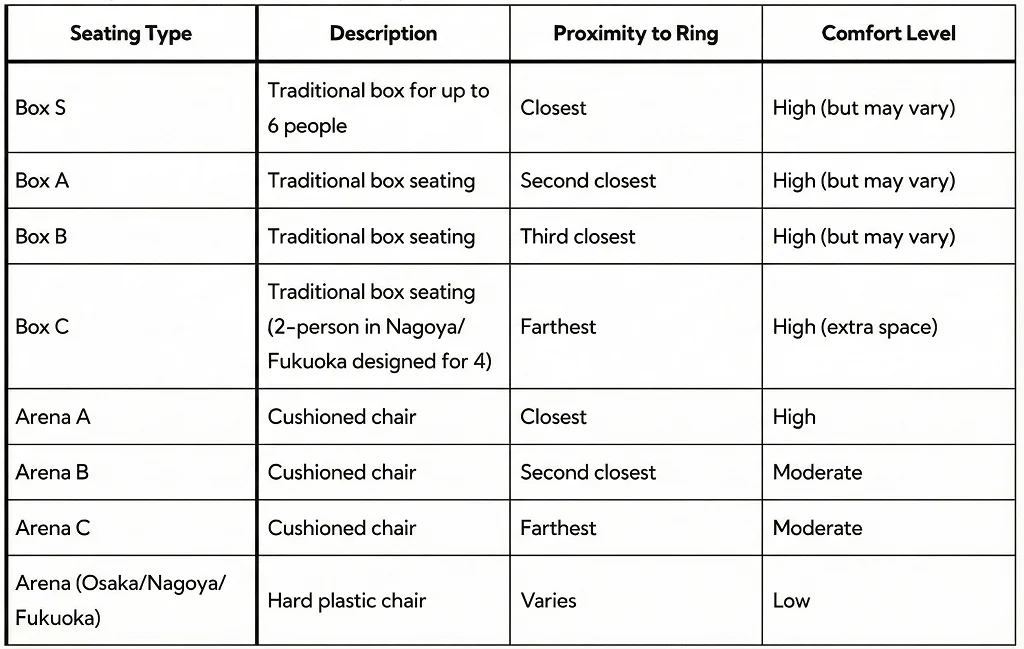
Viewing from S-class seats commands a higher price, but B and C class seats can still offer a more than satisfactory experience without straining your wallet.
Size of your group
You may be attending with friends or family, so it’s crucial to consider your group size when considering your seating options. Box seats, designed for small groups, allow you and your companions to sit together and immerse yourselves in the experience.

While box seating is perfect for 1-4 individuals, if your party is larger you may need to opt for stand seats or several sets of box seats to accommodate everyone.
Pros and cons of each seating type
It’s important you consider the pros and cons of the different seating options available during tournaments. Each type of seat offers its own advantages and disadvantages, depending on your priorities for comfort, view, and experience. Below is a breakdown to help you decide.
Arena seats: advantages and disadvantages
A primary consideration for many is the comfort level of Arena seats (sometimes referred to as Stand seats). These seats provide individual fold-down chairs, allowing for better back support during the tournament. While they are positioned at the back of the arena, they still offer a decent view of the action, making them a solid choice for those who prioritize comfort and affordability.

Box seats: advantages and disadvantages
To enhance your experience, consider the unique cultural aspect of box seats. They allow you to truly feel a part of the sumo watching tradition. Also, sharing a box with friends or family creates a communal atmosphere that enhances the enjoyment of the matches.
Disadvantages of box seats include the challenge of securing them, especially during peak event days, and the fact they require sitting on floor cushions without back support. While box seats allow for an immersive experience, this traditional seating can be uncomfortable for longer periods and might not be suitable for everyone.
VIP experiences: advantages and disadvantages
While VIP experiences often include premium seating and exclusive perks, they typically come at a higher price point. This investment may not be justified for those new to sumo or those looking for a more casual viewing experience.

This elevated experience can offer behind-the-scenes insights and a more personal connection to the world of sumo, making it highly appealing to dedicated fans or those seeking a memorable outing. With added amenities, VIP packages ensure that your visit to a sumo tournament is truly special. Viator is the best site to check for VIP packages.
Sumo tickets for children
Children of all ages can watch sumo, including at Ryōgoku Kokugikan, but some require tickets and some don’t depending on their age. Here’s the breakdown:
- Children 3 years old or younger can enter for free if they don’t need their own seat.
- Children aged 4-15 (inclusive) a child ticket is required.
- Children aged 16+ are considered adults.
For age verification, children (under 15 years old) need to bring a document that can confirm their age (student ID card, public certificate with date of birth).
Note: these rules apply to the sumo tournament bouts themselves. Any other special events happening around the tournament may have different rules.
Enhancing your sumo experience
Once again, immersing yourself in the world of sumo goes beyond merely watching matches; there are enriching experiences that can deepen your connection to this iconic sport and its culture. Note: there are more experiences available between tournaments. I have a dedicated guide to 7 Best Sumo Experiences You Can Book Instantly – including a quiz to help you find the best experience to match your needs and interests.
Guided tours of sumo stables
Sumo stables, or “heya,” offer an exclusive look into the daily lives of rikishi (sumo wrestlers). Guided tours in these stables provide you with a rare opportunity to observe training sessions, learn about the rigorous lifestyle these athletes uphold, and understand the deep-rooted traditions and camaraderie within the stable environment.

Chanko Nabe dining experiences
Chanko nabe, the hearty stew traditionally consumed by sumo wrestlers, is a delicious way to engage with sumo culture. This communal dish typically features a blend of proteins and fresh vegetables, highlighting the balanced diet required for a sumo athlete’s rigorous lifestyle.
Cultural performances and ceremonies
On your journey to understand sumo, participating in the cultural performances and ceremonies surrounding the matches enriches your experience. These events deeply reflect the rituals and traditions that have shaped sumo for centuries, showcasing Japan’s heritage.
Stables also often host traditional rituals, allowing you to witness the ceremonial procession of wrestlers as they enter the ring, the dramatic ring-entering ceremonies, and other cultural exhibitions. These performances help you appreciate the profound respect and history that underpins the sport, deepening your understanding and enjoyment of each match you attend.
Ready for your sumo tournament experience?
It isn’t often attending a sports event gives you not only the thrill of the action itself but also a deep insight into a country’s culture and traditions. Attending a sumo tournament delivers on both fronts. Even if you haven’t had an interest in sumo before coming to Japan, I recommend considering adding it to your itinerary, whether you’re travelling solo, as a couple or with friends or family, sumo could turn out to be the best thing you did in Japan!
Recommended For You


Want a Japan trip that perfectly balances the iconic and the authentic? Concierge is my personalised travel planning service crafting journeys that align with your specific interests while incorporating both must-see highlights and hidden gems most tourists miss. Together, we’ll create an experience that goes beyond the surface, connecting you with the Japan you’ve always dreamed of discovering.
I’m Rob, and I’ve been where you are
I understand the struggle of building an itinerary that perfectly balances the iconic and authentic sides of Japan.
That’s why I founded The Real Japan, a place where independent travellers like you can thrive. My passion for sharing Japan beyond the cliches is what drives me.
I offer more that just inspiration; I provide personalised, unique and tailor-made travel plans to take your travels in Japan to the next level.
Want to see how I can transform your Japan travel?
Benefits You Can Choose
Personal Itinerary
A tailor-made Japan Travel Plan matching your personal interests
and preferences
Unique Experiences
A unique Artisan Experiences Plan giving you private access to Japan’s finest craftspeople
Perfect Lodging
Curated accommodation/hotel recommendations based on your needs and criteria
What Clients Say
Practical advice, suggestions and recommendations

“Rob will actually prepare a detailed day-by-day itinerary with activities and day-trip ideas, transport indications and relevant hyper-links to places, guides and other interests.“
Mario Mizzi
Malta
Incredibly valuable to re-working my itinerary

“I was unclear on scheduling and logistics and I needed some advice on the best sights and cities. The service provided by Rob was incredibly valuable to re-working my itinerary. Picking Rob’s brain was extremely useful.”
Martine F
Canada
Saved me more than the cost of the service. Excellent stuff!

“I spent weeks deciding what to do. Just a few tweaks with Rob and I’m now even more excited than ever! For me, the service was to get the best experiences and best use of my time while there.“
Andrew Rondeau
UK
How It Works
Step 1: Book your service
Choose the plan duration that best fits your needs.
I have 4 options to choose from.
Step 2: I’ll handle all the details
I’ll ask you questions, we can jump on a Zoom call,
or you can email me your draft ideas.
Step 3: Your dream Japan
I set aside time to work exclusively on your travel plans.
I deliver your personal solution.
Ways I Can Help You With Concierge
Ready to Get Started?
If you found this post helpful please share it!

RESOURCES
Buy Tickets
Buy tickets for the next sumo tournament (Tickets for the next available sumo tournament can be purchased using this link.)
Take My Sumo Experiences Quiz
Take the Quiz (No email required)
Watch Grand Sumo Online
Official Japanese Sumo Website
Nihon Sumo Kyokai Official Grand Sumo Home Page
Further Reading
7 Best Sumo Experiences You Can Book Instantly
Fukuoka Sumo Tickets – Best Seats & Experiences
Nagoya Sumo Tickets – Best Seats & Experiences
Osaka Sumo Tickets – Best Seats & Experiences
Tokyo Sumo Tickets – Best Seats & Experiences
Hi Rob and TheRealJapan fans. Thanks for adding the Search bar. First thing I did was search for sumo and found this page. Excellent! We were able to see one day of the 2023 Fukuoka tournament and my life was forever changed. The written materials they give you when you enter are great souvenirs. The poster of nine sumos (including, of course, Yokozuna Terunofuji) is now hanging by my rowing machine to give me inspiration. There’s so much to learn and it’s good to have the basics before you go. This is a great overview. Watching NHK’s coverage is a good start, too. So happy our amazing trip to Japan (helped immeasurably by Rob’s tips) lives on six times a year through these tournaments.
Hi Jo – thank you so much for sharing your experiences travelling in Japan and your love of sumo in particular. Which reminds me, I need to go again soon!
Thanks Rob! Glad I found you 🙂 Travelling with my 15yo son in September – in time for the Aki Basho!! Super excited and will start following the wrestlers now. Something I read mentioned age limits for the venue? Any issues with a 15yo at Ryōgoku Kokugikan? Also, is it wise to book all tickets in advance for all bouts we want to see? I will definitely try for the grand final first.
Hi Sheryl, glad you found me!
Children of all ages can watch sumo (including at Ryōgoku Kokugikan) but some require tickets and some don’t depending on their age. Here’s the breakdown:
Children 3 years old or younger can enter for free if they don’t need their own seat.
Children aged 4-15 (inclusive) a child ticket is required.
Children aged 16+ are considered adults.
For age verification, children (under 15 years old) you’ll need bring a document that can confirm their age (student ID card, public certificate with date of birth). Adults (ages 16-59) do not require any age ID.
(Note: these rules apply to the sumo tournament bouts themselves. Any other special events happening around the tournament may have different rules.)
Yes, it’s a very good idea to buy tickets in advance, particularly if you’re looking for the latter stages of a tournament as they are likely to sell out. (A limited number of tickets are available at for purchase at the venue on the day, but the queues for these can start very early, and once the allocation is sold out, that’s it.)
Tickets for the September basho (10th to 24th) go on sale on August 5th. The BuySumoTickets.com website is already accepting pre-orders for the September tournament in Tokyo (10th to 24th).
Hope that helps. Enjoy the sumo!
Good morning, Visiting Japan was a Present to me. We love NHK, it is our “go to” Station! We watch Sumo every time it is on. We love the food, the scenery, the Beauty, and honesty, and the great Respect shown in every way so generously. We appreciate, and so much value your friendship to our Country; Thank you! To be Noble is not one’s Station, it is one’s great Intention to Goodness, Kindness, and Respect: given so graciously to all persons and to our environment. Every person creates … ; I Believe in aknowledeging! RBB
Thanks for sharing your story Rhoda.
NHK is really helpful to those outside of Japan who want to follow the sumo tournaments each year.
Hope you are able to return to Japan before too long.
I had the opportunity to see a Grand Sumo Tournament in Fukuoka in 2017. We had to go to the stadium at 7:30 in the morning to get tickets. They hold out a limited number of seats in the upper corners that are available on a first come first serve basis for that same day. Keep that in mind if you want to see a tournament and you miss out getting tickets before they are “sold out”. It is well worth the extra effort. I think the tickets were 3700 yen each. One of my favorite experiences in Japan. Rob can help you out with several options if you have him plan a trip for you.
Thanks for sharing your experiences Brek. That’s a good reminder about them holding back a limited number of tickets for sale on the day at the stadium. Always worth a try if you haven’t bought tickets in advance and want to try your luck on the day.
Anyone interested in having me help plan their trips to Japan can check out our services here: https://www.therealjapan.com/japan-travel-services
How cool is this Rob? I started following sumo just a little bit when a few sumo-type wrestlers became popular in entertainment-only WWF. Yokozuna comes to mind.
Yokozuna is the higest rank in sumo but I never knew there was a wrestler named that in the WWF. Thanks Ryan for expanding my knowledge!